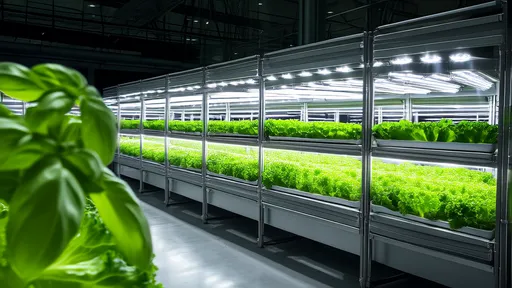
In recent years, indoor vertical farming has emerged as a revolutionary approach to sustainable agriculture, offering a promising solution to the challenges of urbanization, climate change, and food security. Beyond its primary role in food production, this innovative farming method has demonstrated significant potential in improving air quality and environmental purification. The concept of growing crops in stacked layers within controlled environments is not just about maximizing space—it’s about redefining how agriculture interacts with urban ecosystems.
The purification efficacy of indoor vertical farms stems from the natural biological processes of plants. As crops grow, they absorb carbon dioxide and release oxygen through photosynthesis, effectively acting as natural air filters. However, what sets vertical farms apart is their ability to optimize these processes in densely populated urban areas where green spaces are limited. By integrating advanced HVAC systems and air circulation technologies, these farms can capture and neutralize airborne pollutants, including volatile organic compounds (VOCs) and particulate matter, which are common in cities.
One of the most compelling aspects of indoor vertical farming is its scalability. Unlike traditional farms, which require vast tracts of land, vertical farms can be established in repurposed buildings, warehouses, or even underground facilities. This adaptability allows them to be strategically placed in pollution hotspots, such as industrial zones or high-traffic areas, where their air-purifying capabilities can have the most significant impact. Studies have shown that certain crops, like leafy greens and herbs, are particularly effective at removing toxins from the air, making them ideal choices for these systems.
The controlled environment of vertical farms also enables precise monitoring and enhancement of purification processes. By adjusting factors such as light intensity, humidity, and nutrient delivery, operators can maximize the plants' metabolic rates, thereby boosting their air-cleaning performance. For instance, research indicates that exposing plants to specific wavelengths of LED light can accelerate photosynthesis, leading to faster carbon sequestration and higher oxygen output. This level of control is simply unattainable in traditional outdoor farming.
Water usage is another critical factor that contributes to the environmental benefits of vertical farming. These systems typically employ hydroponic or aeroponic techniques, which use up to 95% less water than conventional agriculture. The closed-loop design ensures that water is continuously recycled, minimizing waste and preventing the runoff of harmful fertilizers or pesticides into surrounding ecosystems. This not only conserves precious resources but also reduces the overall ecological footprint of food production.
Beyond air and water purification, indoor vertical farms can play a role in mitigating urban heat islands. The transpiration process—where plants release moisture into the air—has a cooling effect on their surroundings. When implemented on a large scale, vertical farms could help regulate temperatures in densely built urban areas, reducing the energy demand for air conditioning and improving overall livability. Some forward-thinking cities have already begun to explore this potential by incorporating vertical farms into urban planning initiatives.
The integration of renewable energy sources further enhances the sustainability of these systems. Many vertical farms are now powered by solar panels or wind turbines, ensuring that their operations remain carbon-neutral. When combined with their purification capabilities, this makes them a truly holistic solution for urban environmental challenges. Innovations in energy storage and smart grid technology are expected to make these systems even more efficient in the coming years.
Despite these advantages, the widespread adoption of indoor vertical farming for environmental purification faces certain hurdles. High initial setup costs and energy consumption remain significant barriers, particularly in developing regions. However, as technology advances and economies of scale come into play, these challenges are likely to diminish. Governments and private investors are increasingly recognizing the long-term value of these systems, leading to greater funding and support for research and development.
Public awareness and education will also be crucial in driving the adoption of vertical farming for environmental purposes. Many people still perceive these facilities as mere food producers, overlooking their potential as tools for urban revitalization and pollution control. Highlighting successful case studies—such as vertical farms that have measurably improved local air quality—could help shift perceptions and encourage broader implementation.
Looking ahead, the convergence of biotechnology, automation, and data analytics promises to unlock even greater purification capabilities in vertical farming. Imagine farms equipped with AI-driven systems that can dynamically adjust environmental parameters based on real-time pollution data, or genetically optimized plants designed specifically for maximum air filtration. These advancements could transform vertical farms into active participants in urban environmental management, rather than passive food production sites.
The purification efficacy of indoor vertical farming represents more than just an agricultural innovation—it’s a paradigm shift in how we think about the relationship between food systems and environmental health. As cities continue to grow and environmental pressures intensify, these controlled ecosystems offer a viable path toward cleaner air, efficient resource use, and sustainable urban living. While challenges remain, the potential benefits make this an area worthy of continued exploration and investment.

By /Jul 21, 2025

By /Jul 21, 2025
By /Jul 21, 2025

By /Jul 21, 2025

By /Jul 21, 2025

By /Jul 21, 2025

By /Jul 21, 2025

By /Jul 21, 2025

By /Jul 21, 2025

By /Jul 21, 2025

By /Jul 21, 2025

By /Jul 21, 2025

By /Jul 21, 2025

By /Jul 21, 2025
By /Jul 21, 2025

By /Jul 21, 2025

By /Jul 21, 2025

By /Jul 21, 2025

By /Jul 21, 2025

By /Jul 21, 2025