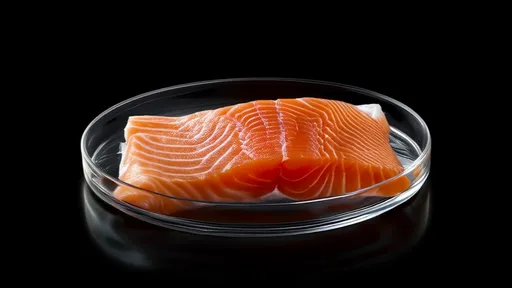
The vibrant pink-orange hue of salmon fillets has long captivated consumers and scientists alike, serving as both a visual marker of quality and a biological puzzle rooted in marine ecosystems. This distinctive coloration stems primarily from astaxanthin, a potent carotenoid pigment that salmon accumulate through their diet of crustaceans and microalgae. Recent advances in spectroscopic analysis have deepened our understanding of how this pigment distributes through muscle tissue, revealing patterns that speak to the fish's life history, nutritional status, and even potential stress responses during migration.
Spectroscopy unveils hidden patterns in salmon pigmentation that the naked eye cannot perceive. Hyperspectral imaging systems, capable of capturing reflectance data across hundreds of narrow wavelength bands, have mapped astaxanthin concentration gradients with unprecedented spatial resolution. These analyses show pigment distribution follows a mosaic pattern rather than uniform dispersion, with denser astaxanthin clusters appearing along myosepta (connective tissue between muscle segments) and near capillary networks. The pigment's localization suggests complex physiological mechanisms for its transport and deposition in muscle fibers, possibly related to antioxidant protection during strenuous swimming activity.
Researchers at Norwegian aquaculture institutes have documented remarkable spectral fingerprints distinguishing farmed from wild salmon. While both show absorption peaks at 472 nm (astaxanthin's characteristic wavelength), wild specimens exhibit broader reflectance spectra between 500-550 nm, indicating secondary pigment interactions. This spectral broadening likely arises from wild salmon's diverse astaxanthin sources - from krill to copepods - each contributing unique carotenoid profiles. Farmed salmon, receiving standardized feed additives, show narrower spectral signatures that enable surprisingly accurate origin tracing through machine learning analysis of reflectance data.
The pigment's distribution tells an evolutionary story written in wavelengths. Arctic salmon populations display unexpected UV reflectance patterns (300-400 nm) absent in temperate varieties, possibly serving as optical signals in low-light polar waters. Raman spectroscopy has identified astaxanthin-protein complexes in deep muscle layers that differ structurally from surface pigments, suggesting distinct functional roles. These subsurface complexes may act as oxygen reservoirs during prolonged dives, while superficial pigments provide photoprotection near the skin. Such findings challenge the simplistic view of astaxanthin as merely a cosmetic trait, positioning it instead as a multifunctional biochemical system fine-tuned by evolution.
Aquaculture nutritionists are applying these insights to optimize feeding regimens. Spectral analysis reveals that pigment uptake efficiency plateaus after 60 days of astaxanthin supplementation, with excess pigment redistributing to visceral organs rather than muscle tissue. This has led to phased feeding strategies that reduce additive use while maintaining desirable coloration. Recent trials with microencapsulated astaxanthin show 23% more efficient muscle deposition compared to standard formulations, as verified through hyperspectral imaging of fillet cross-sections.
Climate change introduces new variables to this chromatic equation. Warming ocean temperatures correlate with altered astaxanthin profiles in wild salmon, detectable through shifts in their reflectance spectra's red-edge (680-730 nm) characteristics. Some populations now show earlier seasonal peaks in pigmentation, possibly linked to changes in zooplankton bloom timing. These subtle spectral modifications serve as early warning indicators of ecological stress, with researchers developing portable spectrometers for rapid field assessments of salmon stocks' health status.
The seafood industry increasingly employs spectral grading systems that analyze astaxanthin distribution patterns to predict fillet quality. Uniform pigment dispersion correlates with firmer texture and higher omega-3 content, while patchy distributions often indicate pre-harvest stress. Advanced systems can now scan 20,000 fillets per hour, classifying them into premium categories based on multivariate analysis of reflectance spectra. This non-destructive method has reduced color-related product rejections by 40% in major processing plants while providing valuable feedback to upstream producers.
Emerging research explores astaxanthin's spectral interactions with other muscle components. Fluorescence spectroscopy has revealed energy transfer between the pigment and membrane phospholipids, suggesting antioxidant synergy that could influence flesh stability post-mortem. Such findings may lead to novel processing techniques that preserve both color and nutritional value. Meanwhile, terahertz spectroscopy shows promise for detecting astaxanthin oxidation products - a common quality defect - through characteristic absorption dips at 0.85 THz.
From laboratory to consumer table, the story of salmon's color continues to unfold through light's interaction with molecules. As spectroscopic technologies advance, they reveal ever-deeper layers of complexity in what initially appears as simple visual appeal. The pink-orange gradient on a salmon steak encodes information about the fish's journey through oceans or farms, its nutritional history, and the hidden biochemical machinery that makes this species both visually and nutritionally remarkable. Future applications may extend to real-time monitoring of fish health through skin reflectance or dynamic adjustment of aquaculture conditions based on spectral feedback - taking our understanding far beyond color measurement into the realm of precision marine biology.

By /Jul 24, 2025

By /Jul 24, 2025
By /Jul 24, 2025
By /Jul 24, 2025

By /Jul 24, 2025
By /Jul 24, 2025
By /Jul 24, 2025
By /Jul 24, 2025

By /Jul 24, 2025
By /Jul 24, 2025
By /Jul 24, 2025

By /Jul 24, 2025

By /Jul 24, 2025

By /Jul 24, 2025

By /Jul 24, 2025

By /Jul 24, 2025
By /Jul 24, 2025

By /Jul 24, 2025
By /Jul 24, 2025

By /Jul 24, 2025